Work doesn’t break in systems. It breaks between them
Work moves across systems, but no one controls what happens next
See how it works
Spatial DNA is a workflow and decision orchestration layer for local governments, cities, towns, counties and utilities. We ensure systems make the right decisions together, so work, time, and money stay aligned.
What is the In - Between
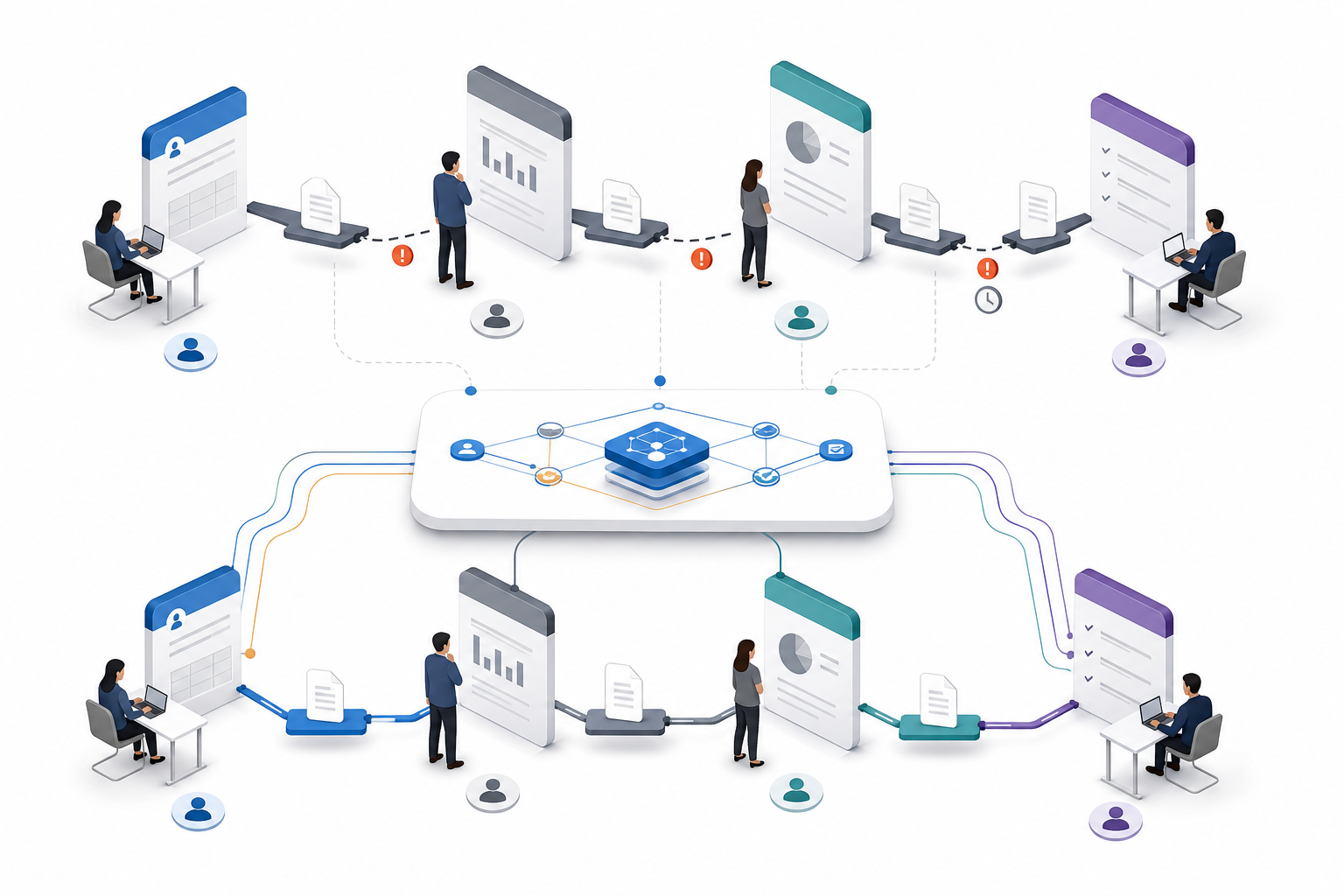
The In-Between is where work moves across systems, teams, and processes.
- It is where a work order moves from field to finance.
- It is where time is recorded, payroll is processed, and cost is applied.
- It is where operational reality becomes financial reality.
This space is not owned by any system.
And that is why it breaks.
Why the In-Between matters
Every enterprise system is designed to operate as a closed environment.
Inside a system:
- Meaning is consistent
- Data has a defined structure
- Actions follow clear rules
- Workflows are controlled
The moment work leaves one system and enters another, those properties disappear.
The In-Between has:
- No shared state
- No consistent timing
- No defined authority
- No enforced decision logic
This is where misalignment begins.
What happens in the In-Between
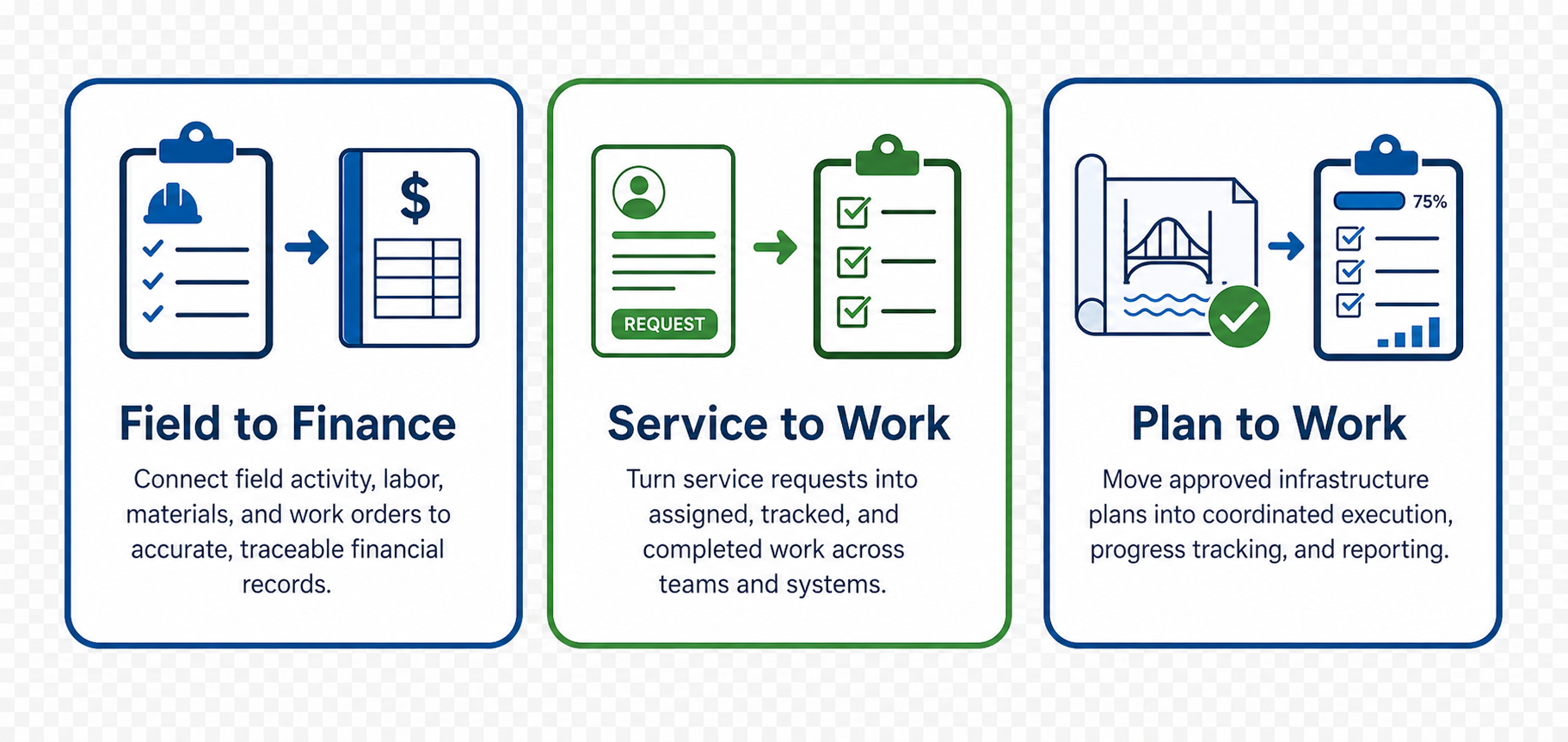
In Field to Finance workflows, the In-Between is where:
A job is completed in the field
Time is entered and adjusted
Payroll processes labour
Finance applies cost
Each system reflects a valid version of the same event.
But they do not agree.
Because no system defines how they should behave together.
• Data follows a consistent structure
• Decisions are governed by clear rules
• Actions are predictable and repeatable
• Workflows are controlled and defined
• Each system maintains its own state
• Authority is clear within the system
No shared definition of state across systems
• Timing is inconsistent between workflows
• No single system owns the decision
• Actions are not enforced across systems
• Data loses meaning as it moves
• Workflows break into manual steps
Status varies across systems
• Labour cost does not match payroll
• Financial periods are exposed to late changes
• Reporting requires manual validation
• Teams rely on reconciliation
• Adjustments happen after the fact
Your systems were never designed to work together
Local government and utility systems are built to operate independently.
Work starts in one system, moves to another, and finishes in a third. Each system performs its role, but no system understands the full workflow from start to finish.
This is where alignment breaks.
Data does not match across systems.
Status is inconsistent at each step.
Decisions are repeated, delayed, or missed entirely.
The work still gets done.
But the cost shows up elsewhere.
In delays.
In errors.
In rework.
In time spent reconciling what should already agree.
Why this happens
- Work management systems track operations.
- Payroll systems process labor on fixed cycles.
- Financial systems enforce accounting rules and reporting periods.
Each system is correct within its own boundaries.
But no system defines how they behave together.

Solutions built for how work actually moves
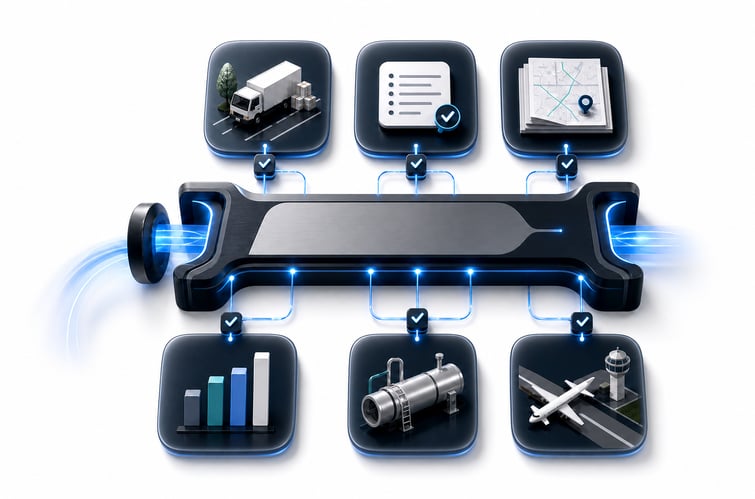
Work does not stay in one system. It moves across many. Each step introduces risk, inconsistency, and manual effort. Our solutions ensure workflows progress correctly, systems stay aligned, and outcomes remain consistent from start to finish.
Infrastructure Workflow Automation
Workflows span multiple systems with no single owner. Spatial DNA ensures work progresses correctly with defined logic, controlled execution, and consistent outcomes across every step.
Asset Management & Prioritization
Asset data exists across systems, but decisions vary. Spatial DNA aligns data, work, and cost so prioritization follows consistent logic and decisions are clear and defensible.
Capital Planning & Coordination
Plans are created in one system and executed in others. Spatial DNA keeps planned and actual work aligned so budgets, timelines, and progress remain consistent.
Service Requests, Permitting & Inspections
Requests, permits, and inspections rely on multiple systems. Spatial DNA ensures each step triggers the next so workflows progress consistently without manual coordination.
Utilities & Field to Finance Operations
Work, time, and cost live in different systems. Spatial DNA ensures they stay aligned so financials reflect reality without manual reconciliation.
Infrastructure Risk & Resilience
Work, time, and cost live in different systems. Spatial DNA ensures they stay aligned so financials reflect reality without manual reconciliation.
Cross-System Data Integrity and Reconciliation
Data moves across systems but does not stay aligned. Spatial DNA ensures consistency by reconciling differences so information, status, and outcomes remain accurate across every system.
Operational Visibility and Auditability
Workflows span systems without a clear view of what happened. Spatial DNA ensures every action is traceable so decisions, changes, and outcomes are visible and auditable.
From fragmented workflows to controlled operations
CEOs, COOs, CTOs
Align decisions across systems with consistent workflows that ensure operations, financials, and outcomes stay reliable.
Asset Managers
Prioritize assets with aligned data and workflows that ensure decisions are consistent, defensible, and repeatable.
City Engineers
Keep projects moving across systems with coordinated workflows that ensure every step progresses correctly.
IT and Finance Leaders
Maintain system integrity with controlled workflows that ensure data, decisions, and outcomes stay consistent.

This is not a connection problem
Systems use different logic, data structures, identifiers, and definitions of truth. There is no shared mechanism to understand state across systems, detect what changed, determine the correct action, or enforce system-of-record authority. Integrations move data. They do not manage decisions.
What our customers say
“The combination of Spatial DNA's expertise in GIS and enterprise integration adds tremendous value to the solutions Deloitte is able to offer our customers. We trust them to bring valuable knowledge, sensitivity to end-user needs, and integration skills to the table; and they deliver every time.” PARTNER, DELOITTE DIGITAL
“We knew that with all the systems we had in place, getting them to talk to each other was important. And doing it in a standard, sustainable, and resilient way—that was the key.” Manager of Applications, Township of Langley
“Just knowing we have an ongoing relationship with Spatial DNA gives our team peace of mind. It’s not a one-time setup anymore — if something changes, it gets addressed.”
Need clarification?
What is Spatial DNA?
Spatial DNA is a data integration and intelligence platform that connects siloed systems, enabling organizations to unify, reconcile, and operationalize data across departments and infrastructure.
Who is Spatial DNA designed for?
Spatial DNA is built for cities, utilities, transportation agencies, and infrastructure operators that need to integrate complex systems and improve operational decision-making.
What problem does Spatial DNA solve?
Spatial DNA is built for cities, utilities, transportation agencies, and infrastructure operators that need to integrate complex systems and improve operational decision-making.
Can Spatial DNA integrate with existing systems?
Yes. Spatial DNA is designed to integrate with legacy and modern systems, including asset management, GIS, IoT, and operational platforms, without requiring a full system replacement.
Is Spatial DNA scalable?
Yes. The platform is built to scale across departments, cities, and enterprise environments, handling growing data volumes and system complexity.